
Teaching in a One Room Schoolhouse
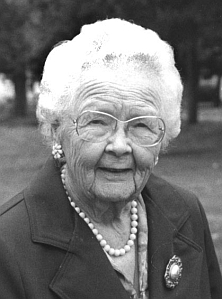 Mrs.
Catherine McHugh of Little Meadows was a teacher for more than 40 years
when she retired from the Owego-Apalachin School District in the early
1970s. But the first part of her career was spent teaching in one-room
schoolhouses in Pennsylvania. In 1924, she taught in Middletown, Pa.,
from 1926 to 1934 she taught at Graves School in Little Meadows, and from
1934 to 1946 she taught at the Little Meadows Schoolhouse.
Mrs.
Catherine McHugh of Little Meadows was a teacher for more than 40 years
when she retired from the Owego-Apalachin School District in the early
1970s. But the first part of her career was spent teaching in one-room
schoolhouses in Pennsylvania. In 1924, she taught in Middletown, Pa.,
from 1926 to 1934 she taught at Graves School in Little Meadows, and from
1934 to 1946 she taught at the Little Meadows Schoolhouse.
Mrs. McHugh's memories of teaching in those one-room schoolhouses provide a nostalgic peek into a time that is very different from today.
It was a time before public transportation or school buses. Everyone walked to school, no matter what the weather. There were no snow days. "You went, that's all," Mrs. McHugh said. "We walked. We could get through."
School started at 9:00 am and ended at 4:00 pm, with a 15 minute recess in the morning and afternoon and a one hour lunch. However, Mrs. McHugh arrived at the school at 7:30. "I had to get the fire started, get it warmed before they'd come," she said, referring to the stove which stood in the middle of the classroom and heated the building. "I kept poking wood all day."
The desks in the classroom were arranged by grades and many desks accommodated two students. Every month, the school provided one pencil and writing tablet for each student. There wouldn't be another until the next month. "You either made it do or do without."
It was a time when religion was part of the curriculum in public schools. The school board mandated that each day start with ten verses of the Bible, the Lord's Prayer, and the Pledge of Allegiance.
The subjects taught included English, Arithmetic, Geography, History, Writing or Penmanship which Mrs. McHugh taught every day using the old Palmer Method, and Spelling. At least once a week they had a spelldown or spelling bee. "It was a good way to promote spelling and the kids liked it."
Classes were ten minutes long and often combined two grades. While Mrs. McHugh was teaching one group, she gave the other children "seat work" to do.
"You had to have eyes on every side of your head. It sounds hectic, but actually wasn't. It was quiet. The whole secret is to keep them busy. Devise things to keep them busy and happy."
It was a time of being self-sufficient, of doing without the luxury of libraries, cafeterias, and gymnasiums that today's consolidated schools couldn't do without.
Mrs. McHugh bought many children's books and read a chapter a day to the students. "My, how they would sit in their seats and just listen. Oh, they liked that."
Everyone brought their lunch and ate it in the schoolroom. Sometimes, Mrs. McHugh would bring in a special treat for the children. "I'd make a batch of soup and we'd have that for (lunch). It tasted good on a real cold day." She would set the soup on the stove to stay warm until lunchtime.
After lunch and during recess, the children - and the teacher - played outside. "I used to go out and play with them a lot," Mrs. McHugh remembers. "I played ball with them. We made up our own games mostly. We used to use horseshoes and play quoits a lot." Other popular games included tag and jump rope. They also played Kick the Wicket in which players laid a stick across two piles of stones, kicked the stick, and scored points based on where it landed.
During winter, sledding on homemade sleds and snowball fights were popular. Mrs. McHugh remembers one big snowstorm at the Little Meadows school when the children rolled snow and made a fort. They chose sides and had a snowball fight. "That fort stayed there for weeks. Boy, we had fun."
The children not only made up their own games, but often had to make their own equipment as well. To make a ball, "you'd start with a piece of rubber," explained Mrs. McHugh, "get twine, and wind it around it. If you were lucky, you'd get a piece of tape. Practically everything was homemade."
In addition to being responsible for educating 30 to 40 students in eight different grades, the teacher in a one-room school was also responsible for the schoolhouse itself. Mrs. McHugh kept the school clean and in winter shoveled a path to the outhouses.
Yes, outhouses. It was also a time when one-room schools often lacked plumbing and electricity. Behind the school stood two outhouses - one for the boys, one for the girls. They even used Sears and Roebuck catalogs which Mrs. McHugh solicited from the community. "Everyone saved their catalog for me," she remembers.
Mrs. McHugh would send some boys "next door" to a farm to get water. The boys brought it back to the school in a container that had a faucet. Everyone had their own cup - there were no paper cups back then. Mrs. McHugh hung each cup on the wall with the child's name over it.
Although Mrs. McHugh remembers having electricity in the Little Meadows school, there was no electricity in the Middletown or Graves Schools. They relied on what light shone through the windows on each side of the schoolroom. Mrs. McHugh remembers having to stand near the windows on dark afternoons so she could read the textbooks.
Mrs. McHugh points out that there were advantages to a one-room schoolhouse. Children "learned from each other, by listening to other classes." They learned to cooperate and get along as a group. And "kids who were quite advanced . . .could help some of the little kids."
Mrs. McHugh passed away last month at the age of 99. Her obituary appears on Page 2.
Editor's Note: Portions of this article originally appeared in The Community Press of October 1995.
The Community Press
a free newspaper, published monthly
serving the Tioga County, New York, area
Copyright 2005 Brown Enterprise and Marketing